









Simple solutions to build teamwork with one department or your entire organization.
Whether you're looking for a facilitator, Five BehaviorsTM Certification, or just to purchase the facilitation resources for your own do-it-yourself programs, our solutions are easy-to-administer and easy-to-afford.
The State of Teams
See what employees fear about post-Covid teamwork.
Identify how team members waste 7 hours every week due to lack of teamwork.
Learn a simple model for evaluating and building team skills.
Everything you need to build a stronger team!

Five Behaviors Profile
Measure your team's strengths and identify areas for improvement. Then, see how you contribute to the team's cohesiveness. You can even see how your Everything DiSC style can help or hurt your team.

Team Building Facilitation
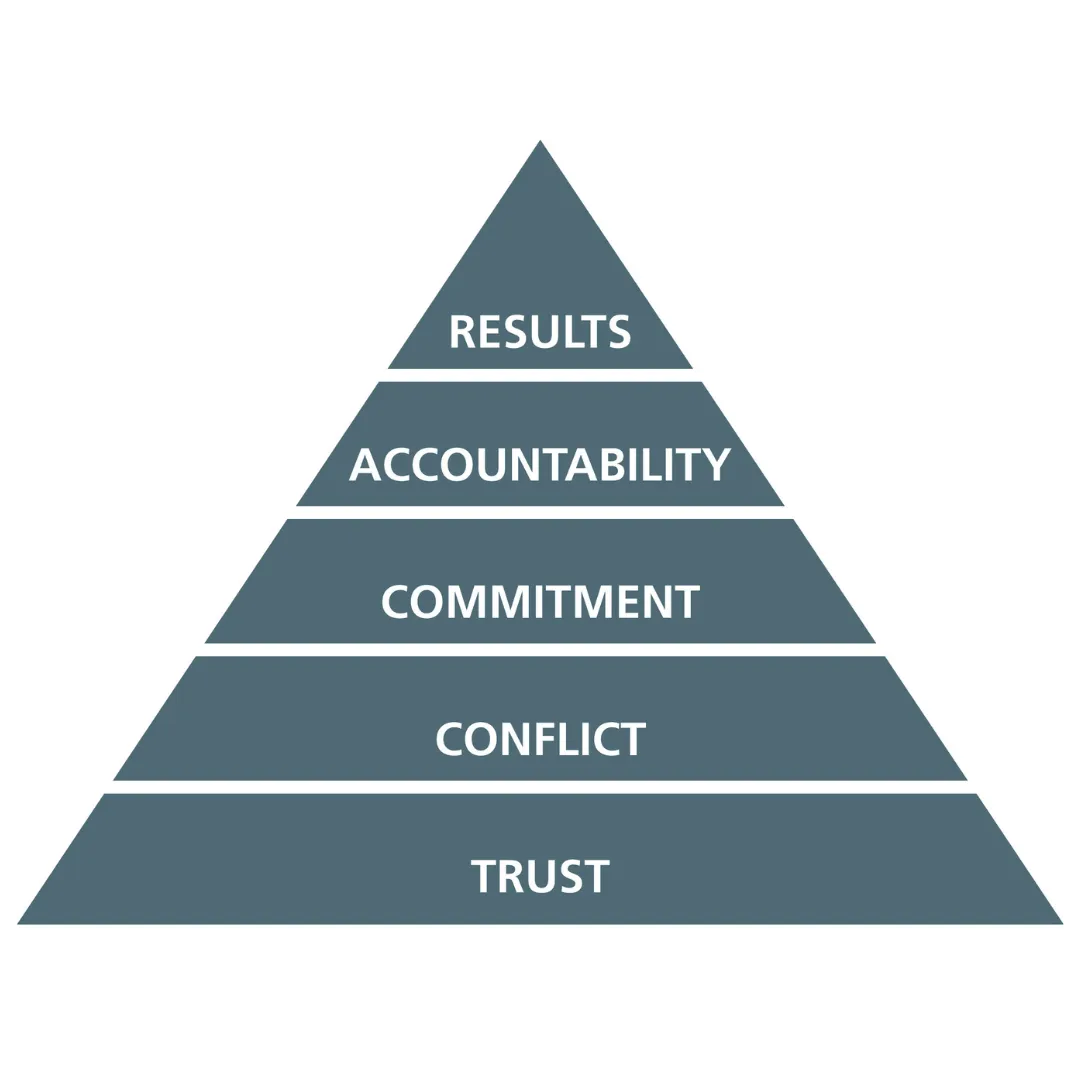
In person or virtual, our team building sessions are interactive, engaging, and insightful. Your team will strengthen trust and develop real frameworks for managing conflict, building commitment, and achieving shared results.

Turnkey Facilitation Tools
Scripts for virtual and in-person sessions, engaging video featuring Patrick Lencioni, Power Point presentations, and certification programs make it easy to facilitate impactful team building sessions.
Your Teambuilding Toolkit
Five Behaviors for Teams
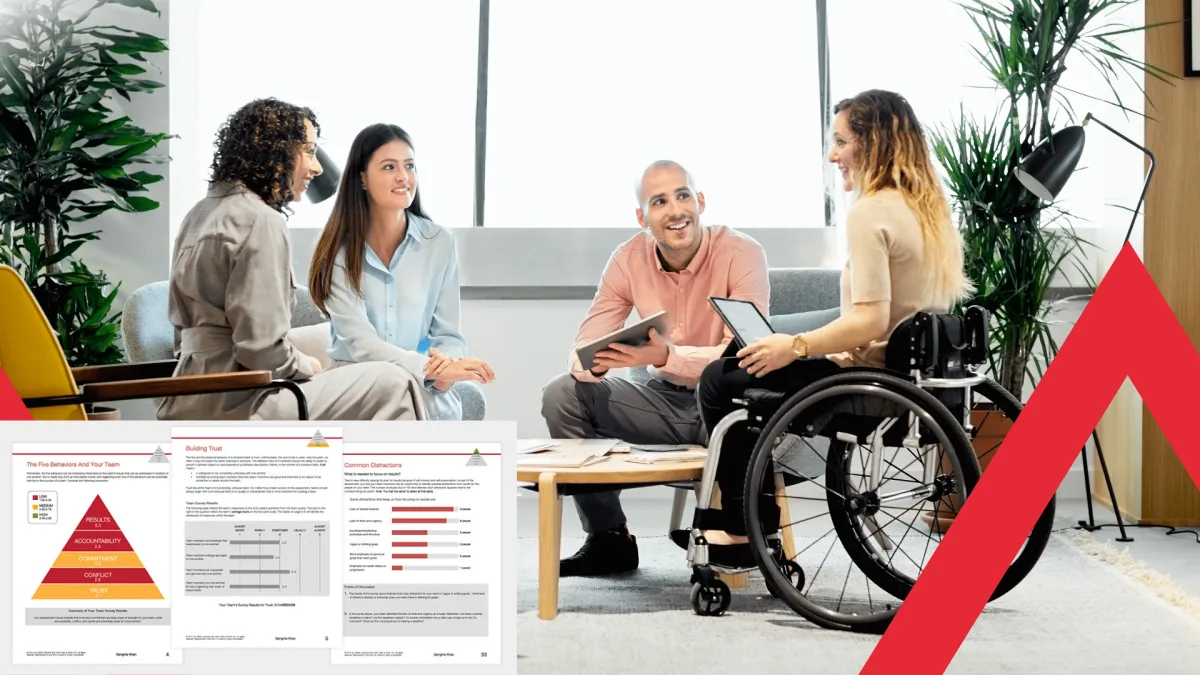
Use data collected from a team survey to identify ways to improve trust, build healthy conflict and commitment, develop peer-to-peer accountability, and focus on shared results.
Team member will see how their DiSC styles contribute to and perhaps, hinder teamwork.
A follow up survey creates a Progress Report to build accountability for change.
This version is best used for intact teams and is designed to be used over three-to-five team sessions.
Five Behaviors Personal Development Profile
Help one individual or your entire organization learn about the five behaviors that lead to being a strong team player.
Our Facilitation Materials make it easy to lead a virtual or in-person workshop where individuals gain self-awareness of their strengths and how they can contribute to strong levels of trust, healthy conflict, commitment, accountability, and shared results.

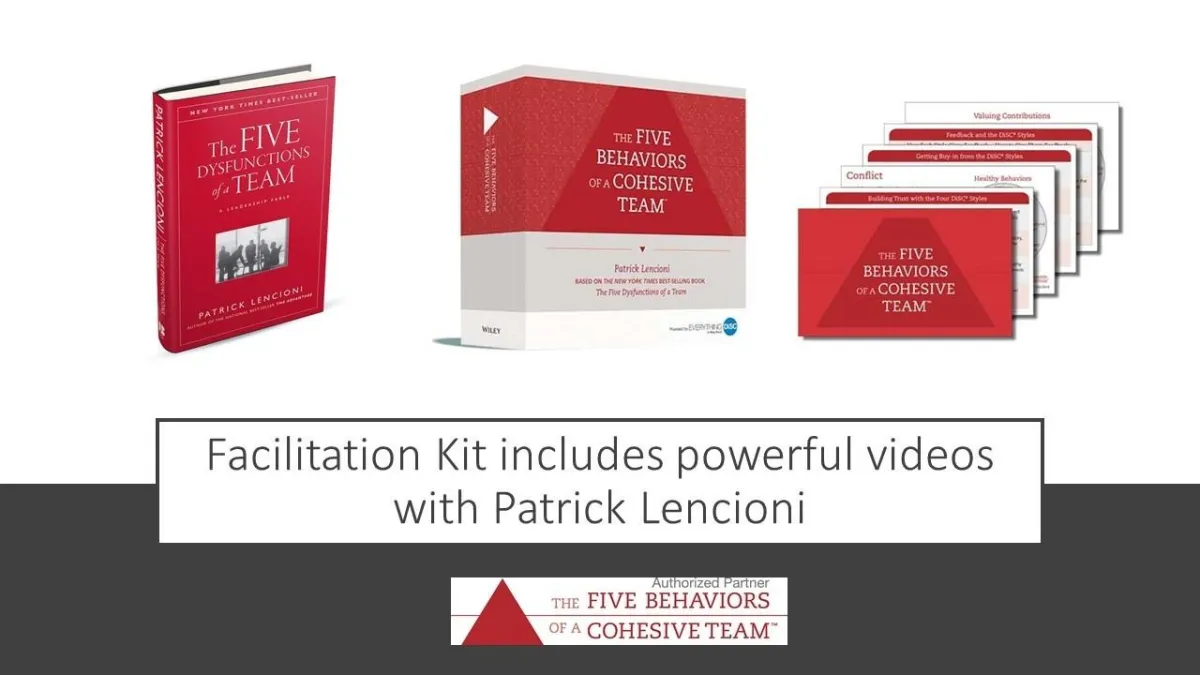
Facilitation Kit
Get the tools you need to lead dynamic team building sessions. Fully scripted sessions, engaging video featuring Patrick Lencioni, and interactive activities are right at your fingertips.
We'll even meet with you to review your team's data and map out a series of activities to achieve your goals.
Need ideas for your team building event?
Schedule a call with us. We'll discuss what's working and what's not. Then, we'll recommend
activities to help you achieve your goals.
Click the images below to achieve your goals.

Assessment
Solutions
Explore our assessments for candidate screening, development, team building, succession planning, and more.

Fabulous
Together
Give the women in your organization the coaching, confidence, and connections they need to have successful careers and a fabulous lives.

e-Learning
Made Easy
Create an amazing learning experience
whether your team is
at the office, at home, or on the go.

Lead
Ignited
Be the best leader you can be
with this award-winning
learning opportunity.
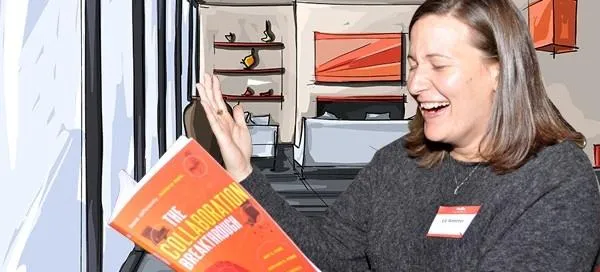
Collaboration
Breakthrough
Create a workplace you love with our best-selling book, employee survey, and interactive team experience.

Coaching
Conversations
Replace your archaic review process
with an online system to
guide GREAT conversations.
Download the Best Interview Questions
for Virtual Job Candidates
Look who's using our assessments today:



Check out our recent news and blog.
What's the best way to launch DiSC in my organization?
Quick Answer:
You know that moment when you're standing in front of a brand new toolkit, full of energy, and completely unsure where to begin? That's exactly where a lot of HR and L&D professionals find themselves after they decide to bring DiSC into their organization. Maybe you just got certified, or maybe your leadership team greenlit the budget and now everyone's looking at you for the plan.
The good news is that you don't need a massive rollout to make a massive impact. Some of the most successful DiSC cultures I've seen started with a small, intentional group and grew from there. The not-so-good news? Most organizations that struggle with DiSC don't have a tool problem. They have a launch problem.
Let's fix that.
The best way to launch DiSC is to start small, start at the top, and tie it to a real business problem. Begin with a pilot group of champions who can model the language and behaviors, then expand strategically through managers and teams using Everything DiSC on Catalyst. In this post, you'll learn about one of my clients who used a six-step sequence for building a culture of DiSC, why most launches lose momentum, and how to avoid the "spray and pray" trap that wastes your investment.
Why do most DiSC launches lose momentum?
I call it the "spray and pray" approach, and it's the number one reason DiSC fades after a few months. Well-meaning facilitators spray DiSC randomly across the organization and pray that it takes hold. They lead one-off workshops for random departments, throw it into a management training sequence, use it in a few conflict resolution conversations, and then wonder why the concepts aren't sticking.
Those activities are effective on a small scale or in the moment. People walk out of the room saying great things. But without a strategic sequence, those good feelings don't have staying power. And they certainly don't maximize the return on your investment.
Here's the sign that you're trapped in the the spray and pray approach: you're administering a bunch of profiles, but there's no tie to a business problem, no plan for what comes next, and no one modeling the behaviors at the top. DiSC gets filed away as "that personality thing we did" instead of becoming a working tool that changes how people communicate, collaborate, and lead.
If that sounds familiar, you're not alone. And the fix isn't complicated. It just takes some intention.
What does a successful DiSC launch actually look like?
One of the best launches I've seen followed a deliberate sequence that built champions at every level before expanding to the broader organization. Here's how it unfolded.
Step 1: Start with the executive team.
Since many of the senior leaders had used DiSC in the past, they kicked things off with Everything DiSC Work of Leaders. This executive-level profile was a smart move because it illustrates how the executives establish vision, build alignment, and champion execution without getting into the weeds. They looked at how their own styles drove organizational culture and how they needed to walk the DiSC talk if they expected others to do the same. That executive buy-in made everything that followed easier.
Step 2: Equip managers with Everything DiSC Management.
Next, the organization brought managers through Everything DiSC Management so they could truly understand how to give direction, delegate, develop, and create a motivating environment for each team member based on their unique DiSC styles. Managers are the ones who carry DiSC into daily work, so giving them their own experience (not just a trickle-down from the executives) was critical.
Step 3: Bring teams onto Everything DiSC on Catalyst.
Some of those managers took the next step and used Everything DiSC Workplace on Catalyst with their teams. Not only did their teams benefit from a new toolkit of conversation strategies, but the managers could use Catalyst to get specific tips for managing each team member. Some even used Catalyst to write better performance reviews, while saving hours of time. When your managers are actively using the platform themselves, their teams take it seriously.
Step 4: Create staying power with Group Conversation Starters.
The teams that embraced DiSC kept it alive through the Group Conversation Starters built right into Catalyst. These 15-minute self-guided exercises gave teams a simple way to drive continued dialogue and team building ideas without requiring a facilitator or a formal event. It took almost no time and kept DiSC part of the conversation. (For more ideas on this, check out my post: How Can I Keep DiSC Alive After a Workshop?)
Step 5: Onboard new employees into the DiSC culture.
They implemented a DiSC for New Team Members class, holding it a few times each year. This gave new employees the opportunity to meet other new hires, learn about themselves, and, using the Managing Up videos in the Management facilitation materials, understand how to make a great impression on their new supervisors. When new hires learn DiSC early, they integrate faster and start contributing to the culture right away. (Related: Using DiSC Assessments to Fast Track Employee Onboarding)
Step 6: Tie DiSC to business strategies and decisions.
This is where things got really powerful. When the organization was driving a major change initiative, they were cognizant of the fact that their senior leaders were high in Dominance and Influence, while 65% of their workforce was strong in Conscientiousness and Steadiness. They didn't want to slow the change process down, but they became more intentional in their communication. They used a visual roadmap to lay out and track progress, and they created project teams based on styles, in addition to functional expertise.
They also embedded DiSC profiles into their HRIS system, their Teams display names, and each department posted their DiSC map. One manager actually blew up a large version of the interaction guide and posted it over his office door. That way, when people walked in, he could quickly glance up and get pointers for having better conversations.
That's what a DiSC culture looks like. It's not one event. It's an integrated approach that shows up in the way people lead, communicate, and make decisions every day.
What role does the Catalyst platform play in a successful launch?
Catalyst is the engine that keeps DiSC running long after the workshops end. It allows learners to create comparisons with their colleagues and to study their own groups before having discussions, making decisions, and taking action.
Think of Catalyst as a real-time coaching tool. It's excellent for identifying ways to influence colleagues, handle tense situations, prepare for coaching conversations, and even guide corrective action language and development plans. The key is to reinforce it when other HR processes are being used: onboarding new employees, handling employee relations questions, building project teams, writing performance reviews, and more.
When Catalyst becomes part of the daily workflow rather than something people only log into during a training session, that's when DiSC truly comes to life.
How long does it take to build a DiSC culture?
Creating a culture of DiSC does take time, especially because your teams are busy doing their actual work. But here's the mindset shift that matters most: don't make DiSC a separate project. Integrate it into what you're already doing.
Using DiSC gives people insight about how to do their work in a way that builds collaboration and communication. When you tie DiSC to existing meetings, project team launches, employee relations discussions, review cycles, etc., it doesn't feel like one more thing on the to-do list.
Your intentional reinforcement of DiSC in day-to-day work will speed up the time it takes for DiSC to really take root in your organization. Most teams start seeing real behavioral shifts within three to six months when DiSC is woven into routine business activities rather than treated as a standalone training initiative.
Do I need to be DiSC certified to launch it?
No, you do not need to be certified. You can facilitate DiSC sessions using the customizable facilitation materials available through the Catalyst Practitioner Experience. It's full of scripts, customizable PowerPoint presentations, engaging videos, and learning activities, all designed so you can embed DiSC at every level of your organization.
Of course, you can also bring in an outside facilitator like me to get things started and then take over from there. The important thing is that you don't let the certification question slow you down. If you want to get certified later because you love it and want to deepen your expertise, that's a great move, but it's not a prerequisite for launching.
Looking for practical ideas for facilitating with Everything DiSC?
🔥 Download: The Everything DiSC Facilitator's Dream Kit for ready-to-use activities, conversation guides, and reinforcement tools.
Want to talk through your launch plan? Schedule a call with me and let's map it out together.