













Get Your Everything DiSC Questions Answered Here!
Whether you are a brand new Certified Everything DiSC Practitioner or someone who is just starting out, you'll find this page full of helpful information.
Need help? Just email me at [email protected].
Watch the videos to learn how to use Catalyst with your learners, to simplify your administrative processes, and to keep learning
Access the new Catalyst Practitioner Experience Platform FREE for one year
Download activities and short-cuts to make your life easier
Keep growing your Everything DiSC practice
Office Hours Recordings
This Fall, I'm hosting Office Hours to share what's new and to answer your questions.
Visit our Upcoming Events page for dates, times, topics, and login information!
Catalyst Basics Video
See the tools available to your learners including micro-learning modules, comparisons with their colleagues, group reports, and personlized tips for success. (12 minutes)
Catalyst Administrator Platform Video
See how easy it can be to manage your profiles, departments, and groups right within Catalyst. (14 minutes)
Worksmart Management Modules
One-hour management training modules and action plans built right in Catalyst: Giving Feedback, Managing Conflict, Empowering Your Team, Navigating Change, Motivating Your Team. Plus step-by-step scripts makes your job as a facilitator a piece of cake! (14 minutes)
Organizing Your Profiles and Dashboard
The more profiles you order, the crazier your Catalyst Admin and EPIC Dashboards can get. Watch this video to get tips and tricks for organizing your files, as well as deleting former employees, and reclaiming unused credits. (20 minutes)
Catalyst Practitioner Experience
See how you can save time by getting all your facilitation materials for Everything DiSC Fundamentals, Workplace, Agile EQ, Management, and the new Worksmart Modules in one place. Plus, FREE Facilitator Reports, Group Culture Reports, and Comparisons! (10 minutes)
Other Resoures to Fuel Your Thinking

Get
Certified
Build your knowledge, toolkit, and confidence to facilitate workshops, teambuilding sessions, coaching conversations, and more.

UPGRADE Your OLD
Facilitator Kit to the Catalyst Practitioner Experience
Get one year access to the new Catalyst Practitioner Experience Platform with upgraded, downloadable facilitation materials and ongoing learning.

Enroll in the NEW Catalyst Practitioner Experience
Don't have a kit? You can enroll in the new Catalyst Practitioner Experience to get Workplace, Management, and Agile EQ facilitation materials plus ongoing training for one year.
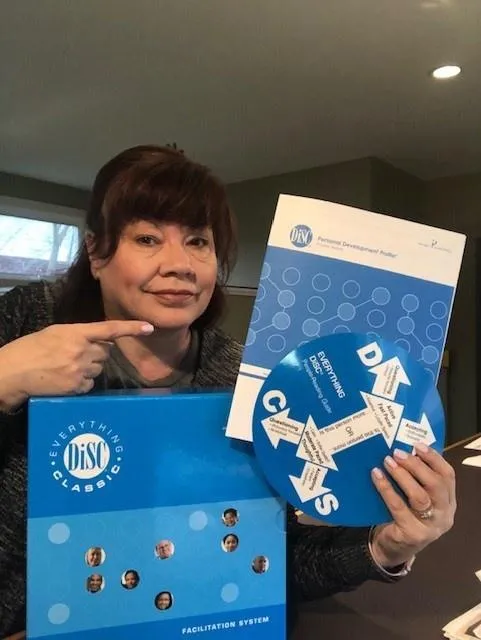
It's time to throw these old DiSC tools away!
Okay, I admit. I don't throw anything away. But, there are so many great new resources available, I think it's time to upgrade!
Whether your looking for new classroom materials, resources to create engaging virtual sessions, tools to create powerful coaching conversations, candidate screening assessments, 360 degree feedback, or turnkey team building materials, I'm here to help.
Feel free to email me at [email protected] to brainstorm ideas or identify ways to achieve your goals.
I appreciate your business and look forward to seeing you soon!
Amy Pearl

Click the images below to achieve your goals.

Assessment
Solutions
Explore our assessments for candidate screening, development, team building, succession planning, and more.

Fabulous
Together
Give the women in your organization the coaching, confidence, and connections they need to have successful careers and a fabulous lives.

e-Learning
Made Easy
Create an amazing learning experience
whether your team is
at the office, at home, or on the go.

Lead
Ignited
Be the best leader you can be
with this award-winning
learning opportunity.

Collaboration
Breakthrough
Create a workplace you love with our best-selling book, employee survey, and interactive team experience.

Coaching
Conversations
Replace your archaic review process
with an online system to
guide GREAT conversations.
Download the Best Interview Questions
for Virtual Job Candidates
Look who's using our assessments today:





Check out our recent news and blog.

What Do Pre-Employment Assessments Actually Measure?
Quick Answer:
A real selection assessment measures three things. How someone thinks. How they tend to behave. And what actually interests them. That’s it. Not vibes. Not whether they seemed likable for the thirty minutes you spent with them in an interview. Not some mystical number that predicts greatness. Thinking Style, Behavioral Traits, and Motivational Interests, measured with enough rigor that you can actually trust the results.
The word “assessment” gets used interchangeably for everything from a five-minute BuzzFeed-style quiz to a rigorously validated selection tool, and most people have never had anyone draw a clear line between the two. So before you sit through another vendor demo, let’s fix that!
My Take On This
At the risk of revealing my age, I've been using candidate screening tools for almost 30 years. Many years ago, I was part of a recruiting firm. We were very fussy and wanted to be ultra-sure we were only putting the best candidates forward. So, we came across the world of using assessments for candidate screening.
Our clients found this assessment insight so valuable that they began asking if they could use our assessments, even if we weren't facilitating the search process. My assessment business was born!
Since then, I've helped clients use assessments for almost every purpose under the sun. In fact, I actually learned a lot about myself by using assessments. For example, I discovered that I hate recruiting, but that's a story for another day.
Another thing I discovered is the PXT Select Profile. It is by far, the best candidate screening tool on the planet because it has three assessments in one to gauge thinking skills, behavioral style, and motivational interests.
3 Things a Candidate Screening Assessment Should Measure
Thinking Style: How Someone Processes Information
Thinking Style is what most people mean when they say “cognitive ability” or "critical thinking skills," even if they’ve never used that phrase out loud. It’s not an IQ test, and it’s definitely not a measure of whether someone is “smart.” It’s a measure of how well someone processes information, solves problems, and communicates what they know.
PXT Select breaks this into four scales: Verbal Skill (vocabulary), Verbal Reasoning (using words to solve problems and draw conclusions), Numerical Ability (basic math competence), and Numeric Reasoning (using numbers to reason through a problem). Roll all four together and you get a Composite Score, which gives you a general sense of someone’s learning and problem-solving potential.
Here’s the part people miss: a higher score isn’t automatically better. Every job calls for a different range. Someone in the top decile of Numeric Skills and Reasoning will likely be bored with a role that’s mostly repetitive and process-driven. In fact, an extremely high thinking style score in a role with little intellectual challenge can create a retention risk. And, we've all probably run into that professorial type with strong verbal skills that leaves the normal humans like me feeling like a dummy. Fit beats “smart” when a job or the culture doesn't need it.
Behavioral Traits: How Someone Tends to Show Up
Behaviors are things like emotional control, sociability, accommodation of others, outlook, and independence.
These traits live on a continuum with two opposite ends, and neither end is “good” or “bad.” Someone who’s steady rather than urgent isn’t lazy, they’re probably calm under pressure. Someone who’s unassuming rather than forceful isn’t weak, they’re likely your best listener in a room full of people trying to talk over each other. The whole point is that behavior is contextual. A trait that’s a liability in one role is a superpower in another. None of this is about finding the “best” score. It’s about finding the right match.
This is exactly why the Performance Model (the tool that maps a position’s ideal ranges or profile) matters so much, and it’s a big enough topic that it gets its own post. For now, just know this: Behavioral Traits tell you how someone naturally operates, not whether they’re a good person or a bad hire.
Interests: What Actually Motivates Someone
Interests are the piece people tend to overlook, and it’s the one I think deserves more attention, not less.
Thinking Style tells you what someone can do. Behavioral Traits tell you how they tend to do it. Interests tell you what they actually want to be doing all day. Skip this piece and you can end up with a technically capable, behaviorally well-suited hire who’s miserable and gone within a year, because nobody checked whether the actual day-to-day work lit them up. If you’ve ever had a “great on paper” hire quietly disengage within six months, this is very often the missing piece.
PXT Select measures six using the Holland Hexagon model: Creative, Enterprising, Financial/Admin, People Service, Mechanical, and Technical.
How the Three Come Together
None of these three sections mean much in isolation. What makes an assessment like PXT Select actually useful is comparing a candidate’s results against a Performance Model, which is essentially a snapshot of the score ranges that have historically predicted success in a specific role. That comparison produces a Percent Fit score for Thinking Style, Behavioral Traits, and Interests individually, and an Overall Fit that blends all three (weighted 40/40/20).
I go deeper into Performance Models and what “Percent Fit” really means in other posts, because there’s a lot of nuance worth understanding before you look at a number like “70%” and assume it means something is wrong. In fact, you'd have a real unicorn if you see a 100% match. The key is to find someone who matches in the areas that are most important for the job and for you, the HR person and ambassador for the organization or the hiring manager who wants to make sure the new hire is a great fit for you and your team
Quick Answers to What People Actually Ask Me About Hiring Assessments
Is a higher score always better? No, and this trips people up constantly. Every scale is contextual to the role. A high score in the wrong context can be just as much of a mismatch as a low one.
What’s the difference between this and a personality quiz I’d find online? Validity and structure. A real selection assessment is built on decades of research tying specific traits to specific job outcomes, uses adaptive testing to keep results reliable, and gets compared against an actual Performance Model for the role. A free online quiz tells you which Netflix character you are. Fun, but not something you should base a hiring decision on.
Can someone’s Behavioral Traits change over time? Some characteristics change as people mature or adapt to a role. Some of you might be familiar with another one of my favorite assessments, Everything DiSC. DiSC helps people understand their day-to-day behaviors and more importantly, it teaches people how to change their behaviors and approach based on the needs of another person or situation. It's a terrific training tool, but shouldn't be used in a hiring context. We've all been in a situation where a candidate is able to adapt their behavior in an interview but then turns out to be very different when they actually show up to work.
For hiring and promotional decisions, ensure you are focused on core personality traits. These are characteristics that are often hereditary or develop through your upbringing, education, and early work experiences. These are more difficult to change. In fact, I help my coaching clients to understand their true personality traits so they can live their authentic style every day.
Assessments like PXT Select or the WorkPlace Big Five Profile are based on the Five Factor Model of Personality. They have a higher degree of validity for truly predicting natural traits that drive day-to-day behaviors.
Are Interests really predictive of job performance? They’re predictive of something arguably more important: motivation, retention and engagement. Someone can be perfectly capable of doing a job and still be a flight risk if the work itself doesn’t interest them.
How long does a pre-screening or employment assessment actually take? It depends on the tool. PXT Select takes about 45 minutes, because remember, it's 3 assessments in one. Although, it uses a feature called Adaptive Testing, which I'll explore in another post. In a nutshell, Adaptive Testing means that the number of questions varies for the candidate based on their answers. Candidates generally find it more engaging than a standard test because the difficulty adjusts to them.
What if a job candidate tries to game the test by picking the “right” answers? It happens. It's called distortion and all valid tools flag it as a possibility. It’s not treated as proof someone lied, just a signal to lean harder on the interview and ask more probing, experience-based questions in that person’s weaker areas. Think of it as a nudge to dig deeper, not always a red card.
Is it legal to use pre-employment tests in hiring? Used correctly, yes, and it’s actually one of the more defensible tools in your process precisely because it’s standardized and research-backed. The key word is “correctly,” which is exactly why I never recommend leaning on assessment results alone.
Where to Learn More About Pre-Employment Assessments
If this is the first time you’ve spent time thinking about candidate screening assessments, I’d recommend you check out 8 Benefits of Using Pre-Employment Tests. That post will help you build the case internally for why this is worth doing at all.
If you'd like to learn more about PXT Select, you can download a sample report here.
Either way, don’t sit on this information. Your organization isn't waiting around for you to get comfortable with a new tool.
Stay Ignited!